Still Shipping Today
Seven years in, the product page is still live.
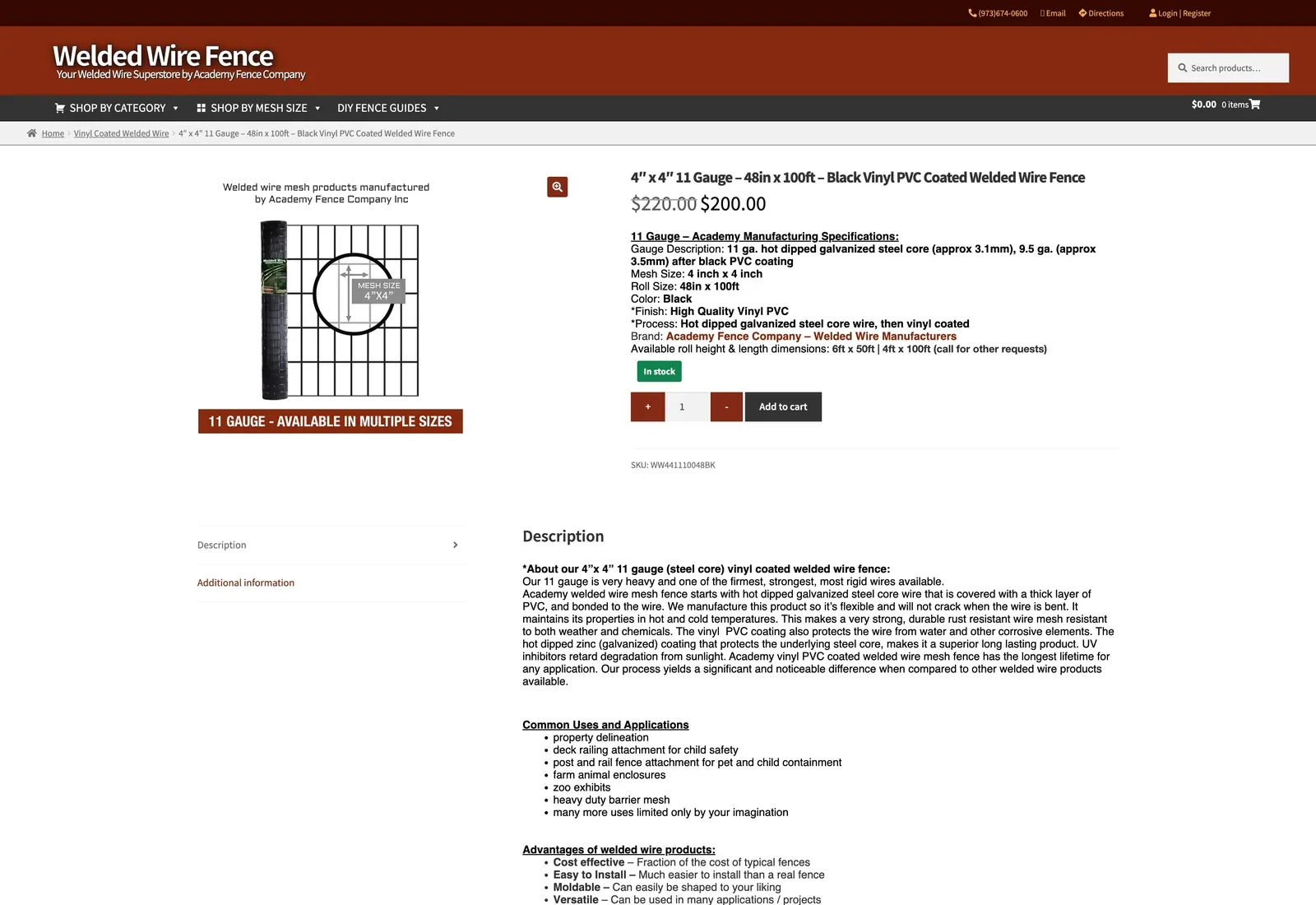
Current Product Page — pricing, "In Stock" status, Add to Cart, and the 11-gauge manufacturing specs. Built in 2019. Still transacting in 2026.
A 60-year-old New Jersey fence manufacturer. A dying satellite e-commerce site, averaging four orders a month. One focused rebuild later: 6.7× the monthly revenue, 9× the order volume, and a platform that's still operating seven years on — without a replatform.
When the engagement began in 2019, the client had been in continuous operation for six decades and had processed more than $23 million across its digital and showroom channels over the preceding ten years. The fundamentals were sound — but the digital infrastructure had been deteriorating for years.
The highest-performing satellite site had declined from a 2016 peak of $131,000 annually to a projected $26,000 for 2019 — roughly four orders a month. The main site was down 64% from its 2014 peak. Every online channel told the same story of slow decline.
The main platform ran on an end-of-life server OS and an end-of-life PHP runtime. Customer credit card data was stored in a non-PCI-compliant manner — an active liability. The e-commerce engine was a custom, undocumented framework maintainable only by a single former employee who was no longer on staff.
Invoice generation was automated, but invoice processing for shipping was manual on every order. Freight was calculated by hand from weight plus destination state — with regular errors. Every product shipped with a hardcoded 2-week lead time. Refunds required logging into the payment gateway and processing each one manually.
Product was stored at a warehouse 15 minutes away. Every order required a physical retrieval trip before it could ship — a drag on throughput, delivery times, and margin.
VimNetworks presented the client with their own data — multi-year revenue trends from the client's internal OMS, Google Analytics traffic, and a formal technical audit. The diagnosis was unambiguous: the digital channels were bleeding, the platform was a security risk, and a migration was overdue.
The client was not yet ready to commit capital to a full main-site rebuild. A different path was required to establish the evidence base.
The proposed pivot: rebuild the highest-performing satellite site — dedicated to welded wire fencing — as a focused proof of concept. If the rebuilt satellite materially outperformed the baseline, it would produce the evidence needed to justify broader platform investment.
Platform selection was contested. An external advisor recommended Magento. VimNetworks advocated for WooCommerce on four grounds: a significantly larger developer pool, a proven operational track record at this scale, ecosystem breadth across shipping and payments and marketing, and lower total cost of ownership over a multi-year horizon.
WooCommerce was approved. Seven years of continuous operation have since validated the call.
Approximately 500 hours of focused development across twelve calendar months, delivered by a single operator working part-time alongside concurrent IT support, customer service, showroom coverage, and product photography for the same client.
Custom WooCommerce store on WordPress — built for how this business actually sells.
The durable value. Manual effort on every order — eliminated.
An information-rich catalog customers could actually shop.
Pre-rebuild versus post-rebuild, drawn directly from the client's own OMS reporting — not modeled, not estimated, not pulled from Google Analytics.
Current Product Page — pricing, "In Stock" status, Add to Cart, and the 11-gauge manufacturing specs. Built in 2019. Still transacting in 2026.
The platform has operated continuously for seven years with no replatforming, no major refactor, and no significant downtime events.
The client has independently expanded the catalog beyond the original scope — Deer Fencing, Tools & Accessories, Steel/Wood/Knock-In Posts, Erosion Control Silt Fence — all absorbed by the original architecture without rebuild.
5-star verified customer reviews have accumulated consistently across the life of the platform.
When the client subsequently rebuilt their main company site under a separate engagement, they adopted the mesh-size taxonomy and category architecture originally developed for this satellite project.
Both sites now operate in parallel — the satellite as specialized conversion funnel, the main site as catalog hub — on architecture that traces back to this rebuild.
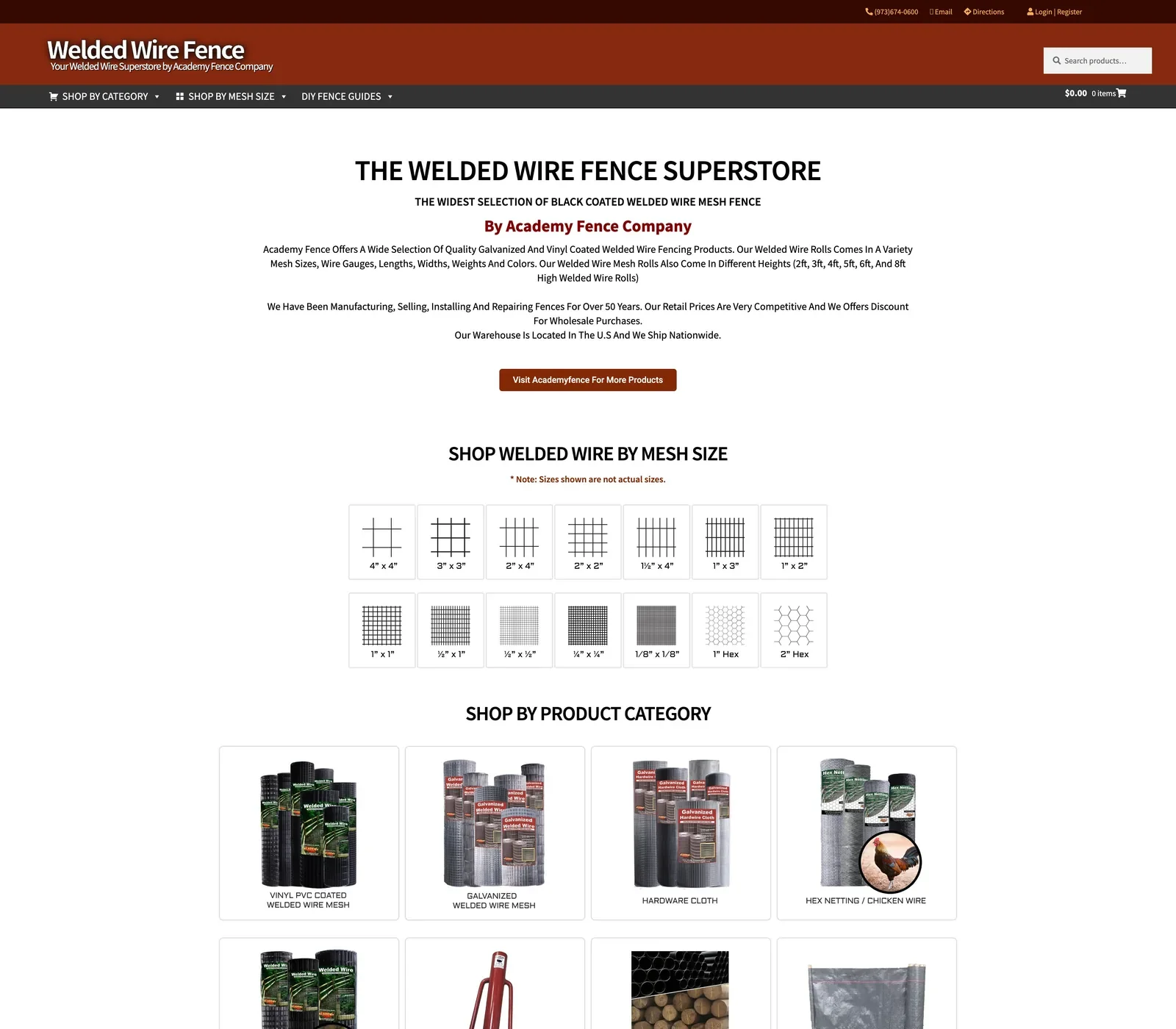
Current Homepage — the mesh-size taxonomy and product category architecture from the 2019 build, now organizing the full product line the client independently grew.
Rather than forcing consensus on a full main-site rebuild, a focused deliverable on the highest-potential product line produced the evidence base that later justified broader investment. This pattern is reusable with any client where the decision-making structure is cautious or divided.
WooCommerce was chosen against an external advisor's recommendation of Magento. Seven years of continuous operation — including staff-driven catalog expansion without developer intervention — has validated the choice against the alternative.
The revenue lift was significant. The more durable value was the elimination of manual effort on every order: automated invoicing, real-time shipping, one-click refunds, daily fulfillment replacing per-order warehouse runs. Those savings compound every day the platform runs.
The work spanned e-commerce architecture and build, UX and information design, product photography and infographic design, CRM selection and migration, shipping and payment integrations, staff training, and server administration — approximately 500 hours of focused development across twelve months.
At VimNetworks' current rate of $150/hour, an equivalent project-scope engagement prices at approximately $75,000. A platform built for that investment has now returned seven years and counting of compounding operational value.
No pitch decks. No discovery calls designed to sell you. Just an honest 20-minute conversation about where your technology is and what's possible.