Case Study · LaneHoney · 2016 – 2017

Hired for the frontend. Trusted with the product.

A venture-backed NYC freight-tech startup. A multi-disciplinary team of founders, designers, UX leads, and backend engineers. Eight days from signed contracts to a live HTML protosite — and fourteen months of continuous build inside the team, from frontend implementation to UX prototyping to product consulting.

Client LaneHoney, LLC
Sector Freight Tech · Venture-Backed Startup
Stack HTML · Sass · Bootstrap · Bower · JS
Engagement 14 months · Aug 2016 – Nov 2017
8 days
From signed contracts to live HTML protosite
14 mo
Continuous embedded engagement with the team
20+
Distinct product surfaces designed & built
3
Roles held across the engagement: frontend, UX, consulting
1
Outside contractor on a ten-person product team

A team in motion. A product being built in parallel.

LaneHoney was a Manhattan-based freight-tech startup building a two-sided marketplace for shippers and carriers — "Fair rates. Sweeter margins. Transparent pricing." The founding team at 21 W 46th Street had a CEO, a product lead, a visual designer, a UX lead, backend engineers, and a partner engineering team. What they didn't have was dedicated frontend execution that could keep pace with a weekly product cadence.

A multi-disciplinary team shipping weekly

Weekly Wednesday meetings at the NYC office. Pivotal Tracker velocity. Zeplin design handoffs mid-flight. Backend teammates shipping in parallel on a separate repo. Whoever owned the frontend needed to plug in without slowing anyone else down.

A design system being built while shipping

Visual design was evolving as the product matured — frequent style-guide updates, color palette shifts, component evolution. The frontend implementation had to ship against a moving target, and stay synced with Zeplin as the source of truth.

A feature surface broader than a marketing site

LaneHoney was a full authenticated product: lane subscriptions, price history, carrier credentials, W9 e-signing, in-product messaging, ACH payment configuration, and mobile-responsive across every surface. Not a brochure site — a live two-sided marketplace with real workflows.

An ambition bigger than the initial scope

What started as a landing-page-and-signup build grew into a year-plus of continuous feature work. The frontend engineer they hired would need to absorb scope expansion gracefully — and eventually, as trust built, take on work well beyond the original contract.

Plug in fast. Stay in sync. Expand with trust.

Contracts were signed on August 8, 2016 — three of them: Consulting, NDA, and PIIA. By Tuesday, August 16 — eight days later — the preliminary HTML protosite was live at a staging URL, with the landing page composition (a truck overlaid across two regional maps), all inner content pages (Fair Market Rates, About Us, FAQ, Terms, Privacy), and working modal windows for Login, Signup, and Password Recovery.

That set the tempo for what followed. Weekly Friday commits. Attendance on the Wednesday 10am–12pm recurring meeting. Integration into the team's Pivotal Tracker workflow. Every Zeplin update translated to production-ready HTML, CSS (via Sass), and JavaScript within the week.

The engagement grew as the trust did. Over the next fourteen months, the scope expanded from frontend implementation into product feature build-out — Carrier Profile, W9 workflow, Messages, ACH Payment, MailChimp templates — and by year two, into UX prototyping: clickable wireframes for revised signup flows, desktop "augmented" prototypes for team review, and consulting sessions with the CEO and UX lead on product direction.

The title on the contract was frontend engineer. By the end, the role was embedded product collaborator.

Fourteen months of work. Three pillars of delivery.

What was originally a frontend contract became three concurrent roles on the same team — each expanding as the team trusted VimNetworks with more surface area.

01

Frontend Implementation

The original mandate. Zeplin in, production HTML/CSS/JS out — on a weekly commit cadence.

  • Landing page with custom truck-over-map composition
  • Inner content pages: Fair Market Rates, About, FAQ, Terms, Privacy
  • Modal system: Login, Signup (Shipper + Carrier with DOT #), Reset Password
  • Authenticated dashboard with sortable Lanes table
  • Responsive mobile + desktop across every surface
  • Sass / Bower / Bootstrap pipeline; progressbar.js, matchHeight, AnimateScroll, bootstrap-touchspin
02

Product Feature Build-Out

The scope expansion. As the roadmap grew, so did the frontend surface — flows, workflows, and integrations.

  • Carrier Profile with Profile Completeness widget
  • My Equipment section with hide/show interaction design
  • Share My Profile flow
  • W9 e-sign workflow — five signed-form pages, two modals, RightSignature integration
  • Messages system — desktop + mobile with iOS-bubble chat, document attachments
  • ACH Payment / My Payment Information (banking info with validation)
  • Carrier Packet mobile flow: Share → Sign → Done, with FMCSA credentials
  • MailChimp transactional email templates ("Carrier packet from USDOT...")
03

UX Prototyping & Consulting

The trust dividend. By year two, the team handed over product-shaping work — not just implementation.

  • Clickable wireframes for revised signup flows — 20 UX screens across shipper, broker, and carrier paths
  • "I need a truck" / "I need a load" flow prototypes
  • Clickable PDFs + short video walkthroughs for team review
  • Desktop "augmented" signup flow iterations
  • On-site working days at the LH NYC office — meetings with CEO, UX, and dev
  • Design-dev-seam negotiation: upstream tweaks to make implementation cleaner

From signed contracts to fourteen months in.

A condensed record of what shipped when. Drawn from contemporaneous emails, invoices, and commit history.

Aug 8, 2016

Engagement begins

Three contracts signed the same evening: Consulting, NDA, and PIIA. Onboarded to the team the following day — Welcome email from the CEO, in-person kickoff at the WorkHouse NYC office (21 W 46th St).

Aug 16, 2016

Preliminary HTML protosite live

Eight days from kickoff: landing page, inner content pages, and functioning Login / Signup / Reset Password modals deployed to the staging URL at loudpixels.com/lh/. Design tweaks negotiated with the visual designer mid-build to resolve a composition challenge in the hero.

Sep 6, 2016

First production-ready handoff

Full web root — HTML, CSS, JavaScript, image assets, fonts, and Sass source — delivered to the CEO, with the backend integration team CC'd. Handoff positioned for engineering pickup.

Sep – Oct 2016

Carrier Profile & auth build-out

New authenticated sections brought online: Carrier Profile with Profile Completeness widget, Create Carrier Profile modal, Share My Profile flow. Sass architecture restructured for the expanding surface; Bootstrap, progressbar.js, matchHeight, and touchspin added to the pipeline.

Oct – Nov 2016

W9 workflow & My Equipment

Full W9 e-sign workflow: five signed-form page assets, two modals, RightSignature placeholder integration, thank-you page with download and email share. My Equipment section built with a hide/show iteration pattern to match the UX team's interaction design.

Nov – Dec 2016

Messages, ACH Payment, MailChimp

In-product Messages system shipped — desktop layout with iOS-bubble mobile chat, document attachments (Contract, Rate Sheet, Job Info), broker-to-carrier conversation flow. ACH Payment / My Payment Information form with banking validation. Transactional MailChimp email templates for the carrier packet flow.

Dec 2016

Mobile prototype iterations

Prototype updates based on revised UX PDFs from the design team: "View Loads" added to Lanes I'm Following table; mobile Market / Radius dashboard with Demand indicator, Verified Posts count, Top Lanes ranking, and Best Paying Loads section.

2017

Role expansion into UX prototyping

Year two brought a different mandate. On-site days at the LH office. New signup flow wireframes (shipper / broker / carrier) — 20 clickable UX screens generated, stitched into review videos and clickable PDFs. "I need a truck" / "I need a load" flows prototyped for CEO review. Desktop-augmented versions of signup flows produced in two variants.

Sep 2017

Peak intensity

A single month's invoice records roughly ninety billable hours — on-site meetings, dev-env setup with backend engineers, clickable wireframe production, UX review sessions, desktop prototype iterations, and Idleair signup requirements gathering. The engagement had long since outgrown its original frontend-only framing.

Oct – Nov 2017

Engagement concludes

After fourteen months, the engagement wound down. The product had shipped, generated marketing collateral, and acquired users; the founding team would continue operating the business independently.

What shipped, and what it looked like.

The product went live. Users signed up. The marketing team produced sales collateral featuring the built-out product surface — the landing page, the carrier-side dashboards, the mobile carrier packet flow, the load board. A snapshot of what fourteen months of work produced:

LaneHoney landing page at launch — the public marketing site built from Zeplin designs into production HTML/CSS

Public landing page at launch — built from Zeplin handoffs, responsive desktop & mobile, with the lane-query console live above the fold.
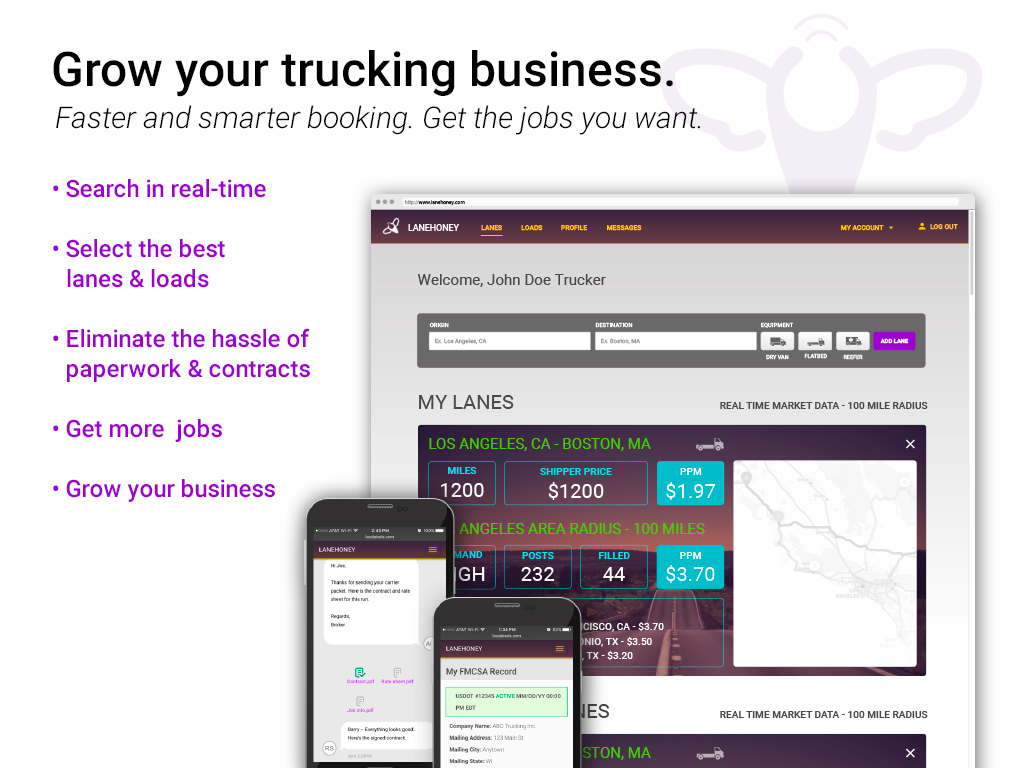
Grow Your Trucking Business — LaneHoney carrier-facing marketing sheet
Carrier Dashboard
My Lanes with map integration, real-time market data, 100-mile-radius demand indicators, and inline carrier packet flow.
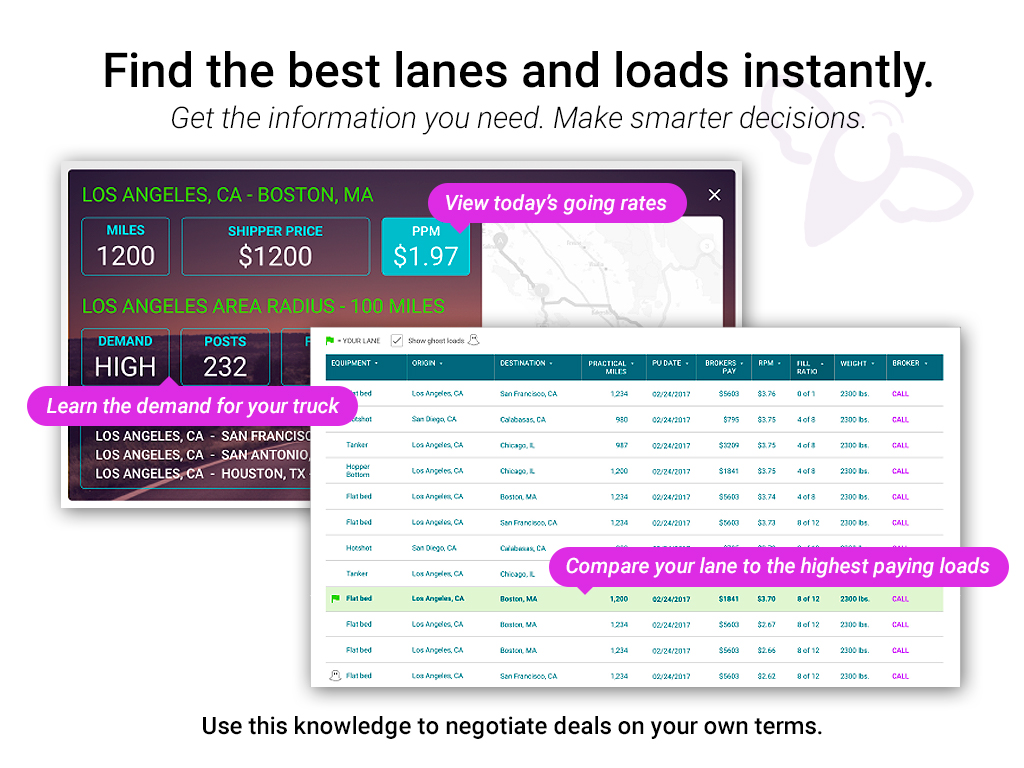
Find the best lanes and loads instantly — LaneHoney load board marketing sheet
Load Board
Live load board with equipment filters, practical miles, broker pay, RPM, fill ratio, weight, and direct call-to-broker links.
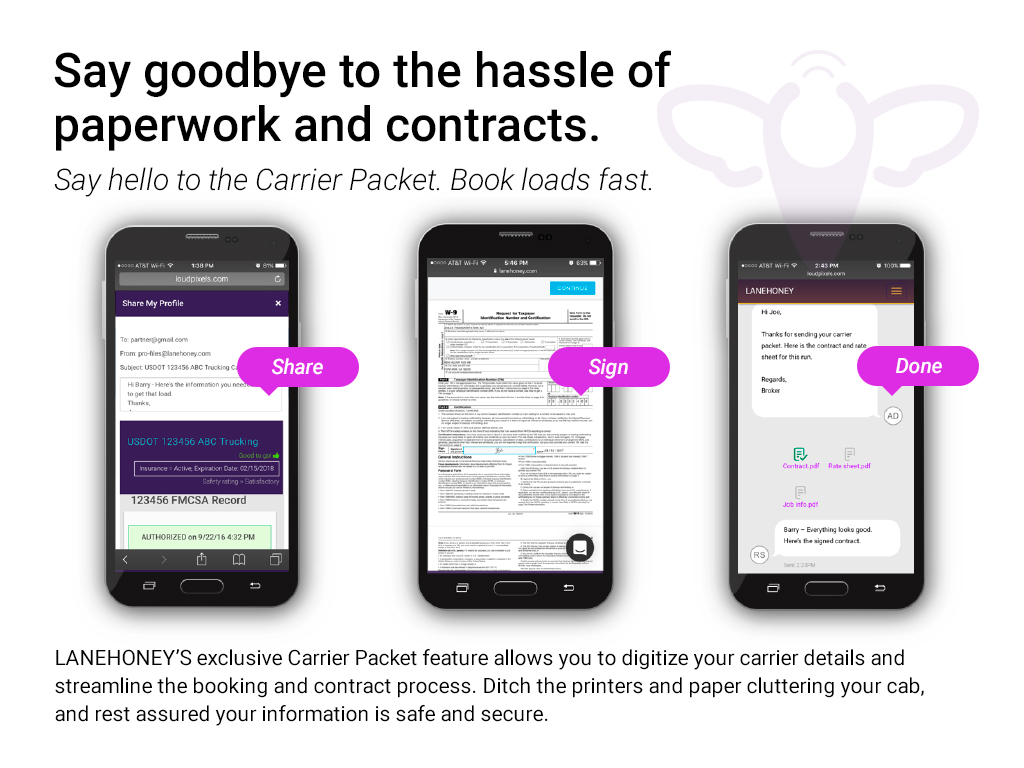
Carrier Packet mobile flow — Share, Sign, Done
Carrier Packet Mobile Flow
Share → Sign → Done. Share profile with broker, sign rate sheet and contract inline, return signed docs — replacing paperwork cluttering the cab.

The product shipped. The company later wound down.

LaneHoney is no longer operating. Like many venture-stage startups, the business did not ultimately find the market traction it needed to continue.

This case study is not a claim about the company's business outcome. It's a record of the engagement — fourteen months of trusted, embedded execution inside a live product team; eight days from signed contracts to a functioning protosite; twenty-plus product surfaces built, prototyped, or consulted on; and a role that expanded, over time, from hired contractor to team collaborator.

What the engagement proves is what VimNetworks brought to the table, not what the company did with it afterward. When the CEO needed a frontend engineer who could plug in on day eight and still be contributing meaningfully on month fourteen, VimNetworks was that person.

The deliverable was always the work. And the work is documented — in commit history, invoices, emails, and the finished product that shipped.

Three things VimNetworks does differently.

I.

Speed into a team, not just speed at a task

Eight days from signed contracts to a live protosite isn't just delivery velocity — it's the ability to absorb an existing team's cadence (Zeplin handoffs, Pivotal Tracker, weekly commits, recurring meetings) without slowing anyone else down. That's what gets a contractor invited to stay.

II.

Craft at the design-dev seam

The interesting work isn't inside a spec — it's at the edges. In the first week on LaneHoney, an upstream conversation with the visual designer resolved a composition problem that would have slowed the build. That kind of negotiation — respectful, implementation-aware, collaborative — compounds across fourteen months of Zeplin handoffs.

III.

Role expansion as a signal of trust

VimNetworks was hired as a frontend engineer. By year two, the mandate covered UX prototyping, clickable wireframe production, on-site consulting, and product-flow design. The team kept handing over more surface area because the previous handoff had gone well. That pattern is reusable — the best contractors end up being treated as team members.

Scope, at current market.

The engagement ran from August 2016 to November 2017 at a contractor rate of $60/hour — representative of solo-operator rates in that era. Work spanned HTML/CSS/JavaScript implementation, Sass architecture, responsive mobile and desktop builds, product feature development, UX wireframing and clickable prototyping, design-team collaboration, and on-site consulting days at the client's NYC office.

Equivalent Scope Today

At VimNetworks' current rate of $150/hour — 2.5× the 2016 rate — an engagement of equivalent duration and surface area prices at a meaningful premium in 2026 dollars. And the breadth has expanded: what was delivered as frontend-plus-UX in 2017 now includes full-stack, AI integration, and platform strategy as part of the same scope.

Need a contractor who can plug into your team?

No pitch decks. No discovery calls designed to sell you. Just an honest 20-minute conversation about where your team is and what you need built.